Home
  • Donate & Join
  • Take Action

RSS

Home ››
Bookmark and Share

Oil-Free, the Steel Interstate Reduces Oil-Dependence Risks

“America is addicted to oil,” [Bumiller, E., and Nagourney, A. "Bush: 'America is addicted to oil'," The New York Times, 2-1-06.] President George W. Bush reported to the nation in his 2006 State of the Union address. “The easily accessible oil has already been sucked up out of the ground,” [AnchorRevkin, A.C., "Obama Restates Need to Seek More Oil Even as U.S. Uses Less," The New York Times, 5-27-10] said President Barack Obama, responding to the massive Gulf oil leak in May, 2010.  North America’s near total dependence on diminishing oil resources for its transportation sector threatens the mobility of people and goods on which we are so heavily dependent for our quality of life.

But political leaders of both parties here and governments around the world are not shooting straight with the people about the risk of oil-dependence. That risk may affect virtually every integrated part of the world economic system. Peaking oil production places the industrialized world on the cusp of transportation chaos. The impacts on civil society and national defense could be catastrophic. At its simplest, “peak oil” is about the application of the law of supply and demand to an increasingly scarce resource--petroleum--in a world where 95% of all products use oil as a feedstock or where oil is essential to production. Food production and transportation top the list.

Peak oil places the industrialized world on the cusp of transportation chaos. The impacts on civil society and national security could be catastrophic.

AnchorAnchorIt is incumbent on our national leaders to openly address issues surrounding the risks of petroleum dependency. Our leaders must  not only inform and educate the public about the risks of Peak Oil but offer meaningful solutions to avoid or mitigate the worst risks to society and the economy.

Clearly, the electrified Steel Interstate System offers the most cost-effective and quickest means to begin to transition our national transportation system from oil-dependent to oil-free. With less than a 1% increase in electric generation, we can displace 12% of total U.S. oil consumption.[Drake, A., Multiple Birds – One Silver BB: A synergistic set of solutions to multiple issues focused on Electrified Railroads, The Oil Drum, 7-15-08.]

When production of oil, worldwide reaches its highest point, its “peak,” production starts to drop off. As President Obama pointed out, the remaining oil is harder and more expensive to extract, because what remains is in remote locations—like the blown out BP Deep Water Horizon well, a mile under the sea, or locked in Canadian tar sands—or beneath unstable or unfriendly nations.
Because all the oil being produced is sold, there will quickly be more customers for oil than there is supply at the prevailing price. That price will begin an inevitable upward spiral and supply interruptions are very likely to occur as nations decide to cut back on petroleum production to preserve their national inheritance for future generations or to speculate on a wildly explosive market.

A couple of years ago, the International Energy Agency's (IEA) projected the world supply of crude oil would increase to above 90 million barrels per day (mb/d) by 2020 and still follow an upward trajectory. Two years before, in 2006, they projected supplies well above 95 mb/d.  The agency has a history of optimistic production forecasts. 
Graph above: Sam Foucher,  theoildrum.com
World oil production (EIA Monthly) for crude oil + NGL. The median forecast is calculated from 15 models that are predicting a peak before 2020 (Bakhtiari, Smith, Staniford, Loglets, Shock model, GBM, ASPO-[70,58,45], Robelius Low/High, HSM,Duncan&Youngquist). 95% of the predictions  sees a production peak between 2008 and 2010 at 77.5 - 85.0 mbpd (The 95% forecast variability area in yellow is computed using a bootstrap technique). The magenta area is the 95% confidence interval for the population-based model.
Graph: International Energy Agency
 
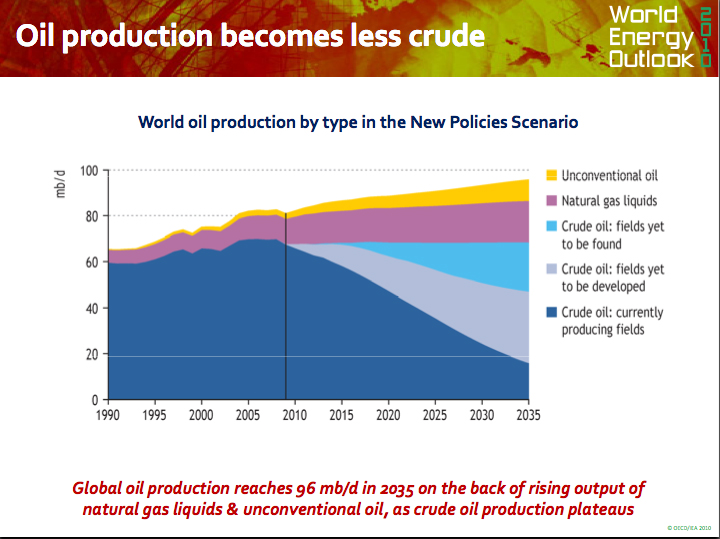
In the November, 2010, edition of the IEA's World Energy Outlook--2010, the IEA reveals in the above graph that conventional petroleum production actually peaked two years ago!
 
Curiously, the IEA predicts a flat line in world petroleum supplies at the slightly below-peak 2009 level. The flat line is achieved by adding enough oil from "crude oil fields yet to be developed" and "crude oil fields yet to be found" to maintain production at current levels. To meet increased demand as it re-tops the 2008 peak, the IEA projects oil supplies from "unconventional" sources will grow to fulfill that demand. Unconventional oil includes primarily Canadian oil sands and Venezuelan extra-heavy oil, but coal-to-liquids, gas-to-liquids and, to a lesser extent, oil shales also would make a growing contribution to fulfill IEA projections.  This means that to meet growing world demand for oil, nations will have to increasingly despoil the environment, add untenably to the world's greenhouse gas burden. Consequently, the World Energy Outlook--2010 fact sheet goes on to outline projections based on a very optimistic plan to reduce worldwide oil demand.
 
Peak Oil blogger, Tom Whipple responded to the IEA's world oil production revisions on November 24, 2010:
 
Before getting into the implications of all this, it is well to remind ourselves that, in the case of this particular publication and set of forecasts, the IEA has a nearly impossible mission. Although in theory independent of the 28 national governments that support the Agency, in reality it has many political masters none of which are as yet ready to grapple with the myriad of problems that will occur when their peoples recognize that significant economic contraction is the only possible course ahead.
 
On the other side of the equation are a growing host of sophisticated IEA watchers who are ready to pounce on any inconsistencies and tear at the Agency’s credibility. Just last year, a whistleblower made headlines by asserting in the British press that the IEA understood that world conventional oil production had peaked, but were under pressure from the “Americans” not to say so.
 
Thus the new document is a blend of dodging and weaving, writing around issues, and having it both ways – oil has peaked, yet it will not peak for another 25 years. There is something – and nothing – for everybody. Kjell Aleklett, the President of ASPO-International, sees this year’s release as a cry for help. The Agency wants to tell the truth, but is constrained by its masters. The answer is to continue its tradition of predicting future demand for oil that permits some semblance of economic growth (although highly constrained) without really making the case that it will ever be possible to fulfill this demand.
 
Last year, the Agency foresaw global oil production reaching 106 mb/d by 2030. This year it forecasts only 99 mb/d by 2035. Aleklett points out that we can interpret this drop as saying that global economic growth is no longer possible. Kenneth Deffeyes, one of the early writers to describe the peak oil phenomenon, points out that the IEA is trying to say “look, oil production peaked five years ago and nothing catastrophic happened” – that is if you ignore the worst global recession in 80 years which certainly was helped along by the $147 a barrel oil we had two years ago.[Whipple, T., The IEA's New Peak, Post-Carbon Institute, 11-24-10.]
 
In an October 30, 2010 speech to the Association for the Study of Peak Oil and Gas-USA, former Secretary of Energy, Secretary of Defense, and Central Intelligence Agency Director James Schlesinger laid out the case that peak oil is real. He summarized that winning the intellectual argument is far from winning policy change. He was far from sanguine,

the "Peakists" ... won the intellectual argument, except for some minor details about precise timing, but that, by and large, everyone recognized that there were limits on our capacity to increase the production of crude oil, as we have, steadily, since World War II. …

But acceptance by knowledgeable people is not enough. The political order should respond. Nonetheless, our willingness, let alone our ability to do anything serious about the impending inability to increase oil output is still a long way off.  The political order responds to what the public believes today, not to what it may come to believe tomorrow. It is also resistant to any action that inflicts pain or sacrifice on those who vote…

We must expect to get along without what has been our critical energy source, in expanding the world's economy for more than half a century.

Can the political order face up to the challenge? There is no reason for optimism. We are likely to see pseudo solutions, misleading alternatives, and sheer sloganeering: energy independence, getting off foreign oil, and the like. All of that sheer sloganeering we have seen to this point.

The political order, which abhors political risk, tends to rely on the Biblical prescription, "Sufficient unto the day, is the evil thereof."[Schlesinger, J., The Peak Oil Debate is Over, presentation to the Association for the Study of Peak Oil and Gas-USA, 10-30-10]

AnchorAnchorStill, it is incumbent on our national leaders to openly address issues surrounding the risks of petroleum dependency. Our leaders must  lead. They must not only inform and educate the public about the risks of Peak Oil but offer meaningful solutions to avoid or mitigate the worst risks to society and the economy. Clearly, the Steel Interstate System offers the most cost-effective and quickest means at our disposal to transition our national transportation system from oil-dependent to oil-free.

There is urgent need for public education about Peak Oil and its potential consequences. Popular reaction in North America to not being able to drive to work dependably, or to drive to grandmother's, not being able to get fresh peaches or even flour, sugar, or cooking oil for a time, could cause citizens to lash out at ill-prepared elected officials and demand easy and dangerous answers. If hunger and massive layoffs should start to spread, so will civil unrest.

The public feels much more entitled now than during the OPEC oil embargoes of 1973-1974 and 1979. At those times, there were still many drivers who recalled the sacrifice of World War II gasoline rationing. Now, support for off-shore drilling remains high in the face of economic and environmental devastation evident from the BP drill rig blow-out. [MSNBC.com, Poll: Despite spill, support for oil drilling high, May 12, 2010.]

Seeing no end to an oil supply or fuel cost crisis may cause people to lose patience or even panic. At the same time, people are feeling more alienated from leading social institutions. There has been a steep decline in public trust in the federal government to function in the public interest since the War in Vietnam. Sharp erosion in public confidence in government has occurred since the public rallied to support the nation in the wake of 9-11. This loss of confidence is paralleled by increasing anger at government. [Pew Research Center for the People and the Press, "Distrust, Discontent, Anger and Partisan Rancor: The People and Their Government," survey, April 18, 2010] Public distrust in large corporations on the eve of the massive BP oil spill in the Gulf was at a level similar to the public’s distrust in government. [Pew Research Center for the People and the Press, "Distrust, Discontent, Anger and Partisan Rancor: The People and Their Government," survey, April 18, 2010.]

In April, 2010, the U.S. Department of Defense, Joint Forces Command, issued a warning that, by 2015, massive worldwide shortages of oil will develop. Crude oil prices will quickly top $100/barrel. [Macalister, Terry, U.S. Military warns oil output may dip causing massive shortages by 2015, Guardian, April 11, 2010.] This warning has been ignored by the press and public officials. [A web search  by the author revealed only one major U.S. media outlet covering the story, The Miami Herald, starting out their story, "In a frightening bit of news...".] Reasonable citizens would expect front page, top-of-the-fold media coverage when the U.S. military forecasts radical impacts on daily life in the our nation and most of the world. But no.

In a September 1, 2010, Der Spiegel article, the German military is reported to be secretly  assessing the strategic consequences of Peak Oil with startling results. Der Spiegel reports:

The issue is so politically explosive that it's remarkable when an institution like the Bundeswehr, the German military, uses the term 'peak oil' at all... .

The study is a product of the Future Analysis department of the Bundeswehr Transformation Center, a think tank tasked with fixing a direction for the German military. The...[study report] uses sometimes dramatic language to depict the consequences of an irreversible depletion of raw materials. It warns of shifts in the global balance of power, of the formation of new relationships based on interdependency, of a decline in importance of the western industrial nations, of the 'total collapse of the markets' and of serious political and economic crises. [Emphasis added.]

According to the German report, there is 'some probability that peak oil will occur around the year 2010 and that the impact on security is expected to be felt 15 to 30 years later.' The Bundeswehr prediction is consistent with those of well-known scientists who assume global oil production has either already passed its peak or will do so this year.

Here are three of the Bundeswehr's seven eye-popping conclusions from its summary of the cascading consequences of peak oil:

  • Oil will determine power: The Bundeswehr Transformation Center writes that oil will become one decisive factor in determining the new landscape of international relations.
  • Market failures: The authors paint a bleak picture of the consequences resulting from a shortage of petroleum. As the transportation of goods depends on crude oil, international trade could be subject to colossal tax hikes. 'Shortages in the supply of vital goods could arise' as a result, for example in food supplies. Oil is used directly or indirectly in the production of 95 percent of all industrial goods. Price shocks could therefore be seen in almost any industry and throughout all stages of the industrial supply chain. 'In the medium term the global economic system and every market-oriented national economy would collapse.' [Emphasis added.]
  • Crisis of political legitimacy: The Bundeswehr study also raises fears for the survival of democracy itself....[creating] 'room for ideological and extremist alternatives to existing forms of government.' Fragmentation of the affected population is likely and could 'in extreme cases lead to open conflict.' [Emphasis added.]

Days earlier, in August, 2010, The Guardian reported that Great Britain has also been secretly investigating potential fallout from peak oil. "The Department of Energy and Climate Change (DECC) is also refusing to hand over policy documents about "peak oil"...under the Freedom of Information (FoI) Act, despite releasing others in which it admits "secrecy around the topic is probably not good". The Guardian recounts that the Observer, using the FoI Act, obtained evidence that representatives from the Ministry of Defence and the Bank of England have met with DECC staff and industry representatives to discuss the implications of  "shortfalls in energy supplies"

The Guardian reported that the International Energy Agency (IEA) is "riven" with disagreement about oil production forecasts being overly optimistic. "an internal IEA source said: "Many inside the organisation believe that maintaining oil supplies at even 90m to 95m barrels a day would be impossible, but there are fears that panic could spread on the financial markets if the figures were brought down further. And the Americans fear the end of oil supremacy because it would threaten their power over access to oil resources."

World population, almost all oil consumers, continues to grow. On a per-capita basis world oil production peaked several decades ago. New emerging demand from nations such as India and China, and resulting upward price pressures in recent years, illustrate dramatically this national dilemma.

The following graph models world oil production and projects future production based on the median projection calcuated from 15 models that predict that peak oil production will occur before 2020. There is a growing consensus, and now even the IEA appears to be joining the consensus, that peak world oil production has recently been reached or will be reached in a matter of a handful of years.

World oil production (EIA Monthly) for crude oil + NGL. [For details on this chart and numerous other calculations.]

http://www.theoildrum.com/files/ccst20090515.png

Sam Foucher, TheOilDrum.com

You can access peak oil guides here and here with detail graphs and forecasts from 2009 here. There are also links to helpful reports and videos on the internet from this U.K. source.

The U.S. Department of Energy’s landmark Hirsh Report [Hirsch, Robert, Bezdek, Roger, and Wendling, Robert, U. S. Department of Energy, February, 2005.] surveyed opinions on this from many petroleum geologists, and the majority said peak world production had occurred or would occur by 2010. Some of the Hirsh Report’s findings have direct relevance to the Steel Interstate System:

Oil peaking will create a severe liquid fuels problem for the transportation sector.

As peaking is approached, liquid fuel prices and price volatility will increase dramatically, and, without timely mitigation, the economic, social, and political costs will be unprecedented. Viable mitigation options exist, but to have substantial impact, they must be initiated more than a decade in advance of peaking.

Aggressive, appropriately timed fuel efficiency and substitute fuel production could provide substantial mitigation.

If worldwide petroleum shortages or huge spikes in oil prices occur, massive social disruption is likely to occur both in North America and across the globe. Without preparation, the world’s the largest consumer of petroleum, the U.S. military, [Karbuz, S., US military oil pains, Energy Bulletin, 2-17-07] could be affected. National defense could be compromised, which is why the U.S. Joint Forces Command is monitoring the issue.

To keep America on the move and our defenses at a high state of readiness, there is no better way to substitute for liquid petroleum than through electrification. Other commonly mentioned methods, such as shale oil, tar sands, and coal liquefaction face production bottlenecks, cost barriers, or environmental problems, or all three, which make them unsuitable candidates for widespread oil substitution.

To wean ourselves from imported oil, we need to begin, now, the critical national planning required to move goods and people in coming decades when oil becomes prohibitively expensive and ultimately unavailable as a transportation fuel. Substituting domestically produced electricity is the key. There are no technical barriers to railroad electrification. The technology is available today and widely used around the world. So the Steel Interstate System would readily move people and products, soldiers and material and keep the U.S., and it’s Canadian and Mexican neighbors, strong and secure by meeting both the food and resource needs of our peoples, and the training and deployment capabilities of our militaries.

For further information:

A Proposed National System of Interstate and Defense RAILROADS as an infrastructure project for the next fifty years, J. William Vargrass, for the National Surface Transportation Policy and Revenue Study Commission.

  • Home
  • Mission
  • About Us
  • Coalition Info.
    • History
    • Coalition Partners / Sponsors / Affiliates
    • Regional Initiatives
    • Discussion Forum
    • Add Your Regional Initiative
  • Toolbox
    • Resources
    • Take Action
  • Contact

Concept

National Security
Economic Dividends
Health & Safety
Fossil Fuel-Free Mobility
Environmental Advantages

This site is new and we are currently uploading content. Please provide feedback.

Check out the latest in our discussion forum.

The North American Steel Interstate Coalition, Copyright 2010. All rights reserved.      Site constructed by Tamarack Media.       Contact us to report site problems.